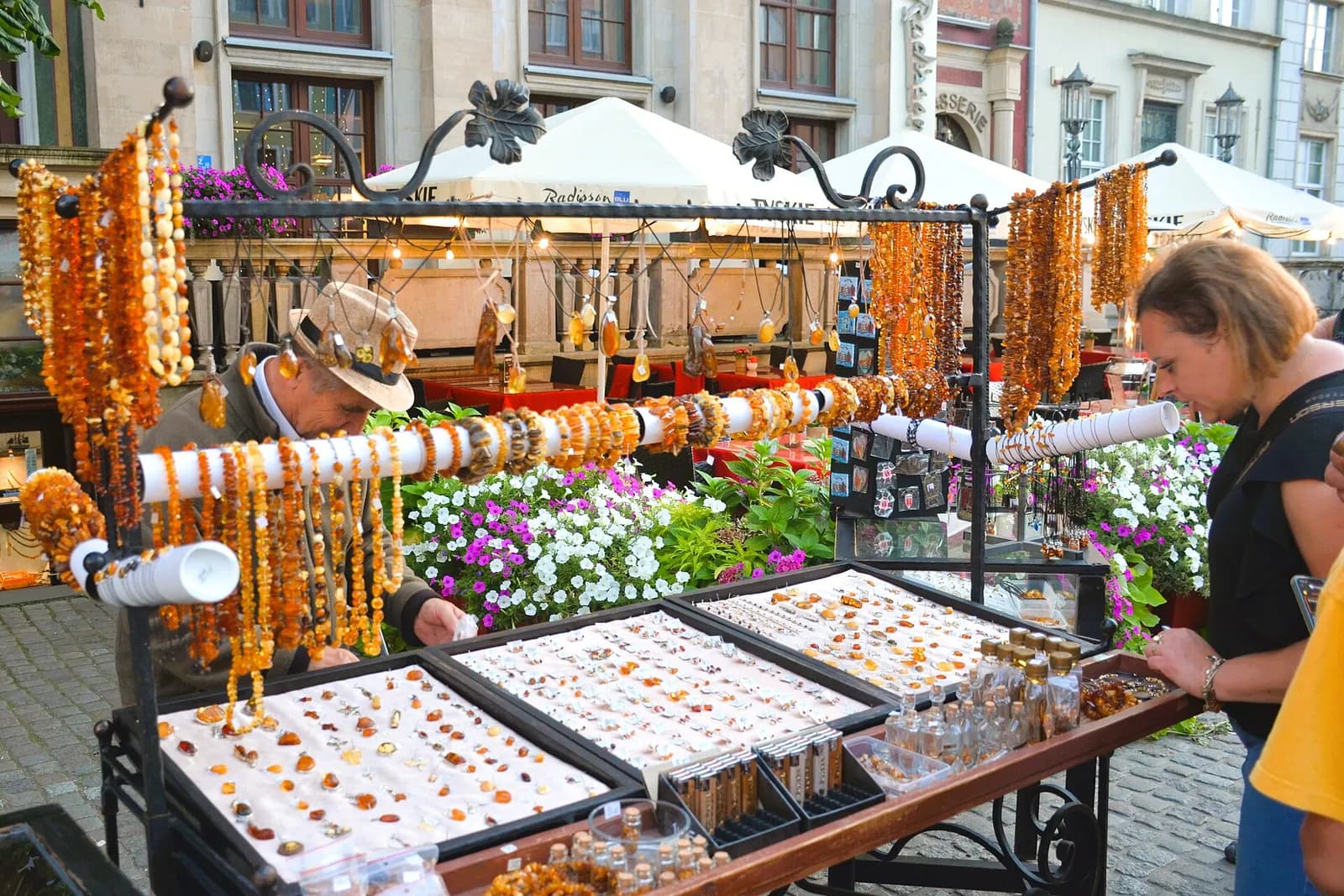
Walk along Mariacka Street and it quickly becomes clear that amber is woven into the identity of Gdańsk. Shop windows glow with honey-coloured jewellery, artisan workshops continue traditions passed down through generations, and visitors from around the world leave with a piece of the Baltic tucked safely into their luggage.
Yet amber is far more than a popular souvenir. It has shaped the city's economy, inspired generations of craftsmen and connected Gdańsk with kingdoms, empires and trading routes across Europe for centuries. Long before it became one of Poland's most recognisable symbols, Baltic amber had already travelled a remarkable journey through time.
A Story That Began Before The Baltic Sea
One of the most fascinating facts about Baltic amber is that it is older than the sea that gives it its name.
Baltic amber is fossilised tree resin that formed around 40 to 45 million years ago during the Late Eocene. Vast forests once covered parts of what is now Northern Europe, producing resin that slowly hardened beneath layers of sediment over millions of years. Through natural geological processes, it eventually became the amber found along today's Baltic coastline.
The Baltic Sea itself would not appear until much later, following the retreat of the last Ice Age glaciers. By then, glaciers and rivers had already carried amber across much of northern Europe before depositing large quantities around the southern Baltic coast.
Scientists refer to Baltic amber as succinite, a variety recognised for its exceptional quality, durability and distinctive chemical composition. It remains one of the world's most prized fossil resins.
The First Luxury Export Of Northern Europe
Long before medieval merchants filled Gdańsk's quaysides, amber was already travelling across the continent.
Ancient trade routes linked the Baltic coast with Central Europe and the Mediterranean, carrying amber south to the Roman Empire. Known today as the Amber Road, these routes transformed fossilised resin into one of antiquity's most valuable luxury goods.
Roman nobles prized Baltic amber for jewellery, decorative objects and ceremonial items. Archaeologists have uncovered Baltic amber in Roman villas, tombs and settlements hundreds of kilometres from its original source, demonstrating just how highly it was valued.
These early trading networks laid the foundations for the Baltic region's reputation as the home of the world's finest amber.
A City Built For Trade
Gdańsk's location on the Baltic coast made it an ideal trading port. As maritime commerce expanded during the Middle Ages, ships carried grain, timber, salt and other valuable goods between Northern and Western Europe. Amber naturally became part of this thriving commercial network.
Following the city's incorporation into the Polish Crown in 1466, Gdańsk entered a period of remarkable prosperity. Wealth generated through trade attracted skilled craftsmen, merchants and artists, many of whom specialised in working with Baltic amber.
In 1477, the city's amber guild was established, introducing professional standards that helped cement Gdańsk's reputation for quality craftsmanship. Over the following centuries, local artisans perfected techniques that transformed raw amber into objects admired throughout Europe.
When Amber Became Art
By the sixteenth and seventeenth centuries, Gdańsk had become Europe's leading centre for amber craftsmanship.
Master craftsmen created far more than necklaces and decorative trinkets. Their workshops produced intricate cabinets, goblets, rosaries, sculptures, caskets and religious works of art, often commissioned by royal courts and wealthy patrons.
Amber became a medium for artistic expression, combining remarkable carving skills with the natural beauty of the fossil itself. Every piece was unique, with colours ranging from pale honey and golden yellow to deep cognac and rich cherry tones.
The city's workshops earned an international reputation for excellence that continues to influence amber design today.
The Mystery That Still Captivates Historians
No discussion of Baltic amber would be complete without mentioning the Amber Room.
Created during the early eighteenth century using elaborately carved Baltic amber panels, the room was later presented to Tsar Peter the Great of Russia and installed in the Catherine Palace near St Petersburg.
During the Second World War, the Amber Room disappeared after being removed by German forces. Despite decades of investigation, its fate remains unknown, making it one of Europe's greatest unsolved cultural mysteries.
Although countless theories continue to emerge, no verified trace of the original room has ever been recovered.
Amber Remains At The Heart Of Gdańsk
Centuries after the first amber guild was established, the city continues to celebrate its unique connection with Baltic amber.
Mariacka Street remains one of Gdańsk's most recognisable destinations, lined with independent jewellers, galleries and workshops where visitors can watch skilled craftsmen at work. The city is also home to internationally recognised amber exhibitions, specialist retailers and museums that preserve both the scientific and artistic history of this remarkable material.
Modern designers continue to reinterpret amber for contemporary audiences, combining traditional craftsmanship with innovative forms and materials. While styles evolve, the connection between Gdańsk and amber remains as strong as ever.
For many visitors, purchasing a piece of Baltic amber marks the end of a holiday. For Gdańsk, it represents a tradition that stretches back millions of years and has helped define the city's place on the world stage.
This enduring relationship between nature, craftsmanship and international trade is the reason Gdańsk continues to be recognised around the world as the capital of Baltic amber.
image credit: Silar, CC BY-SA 4.0