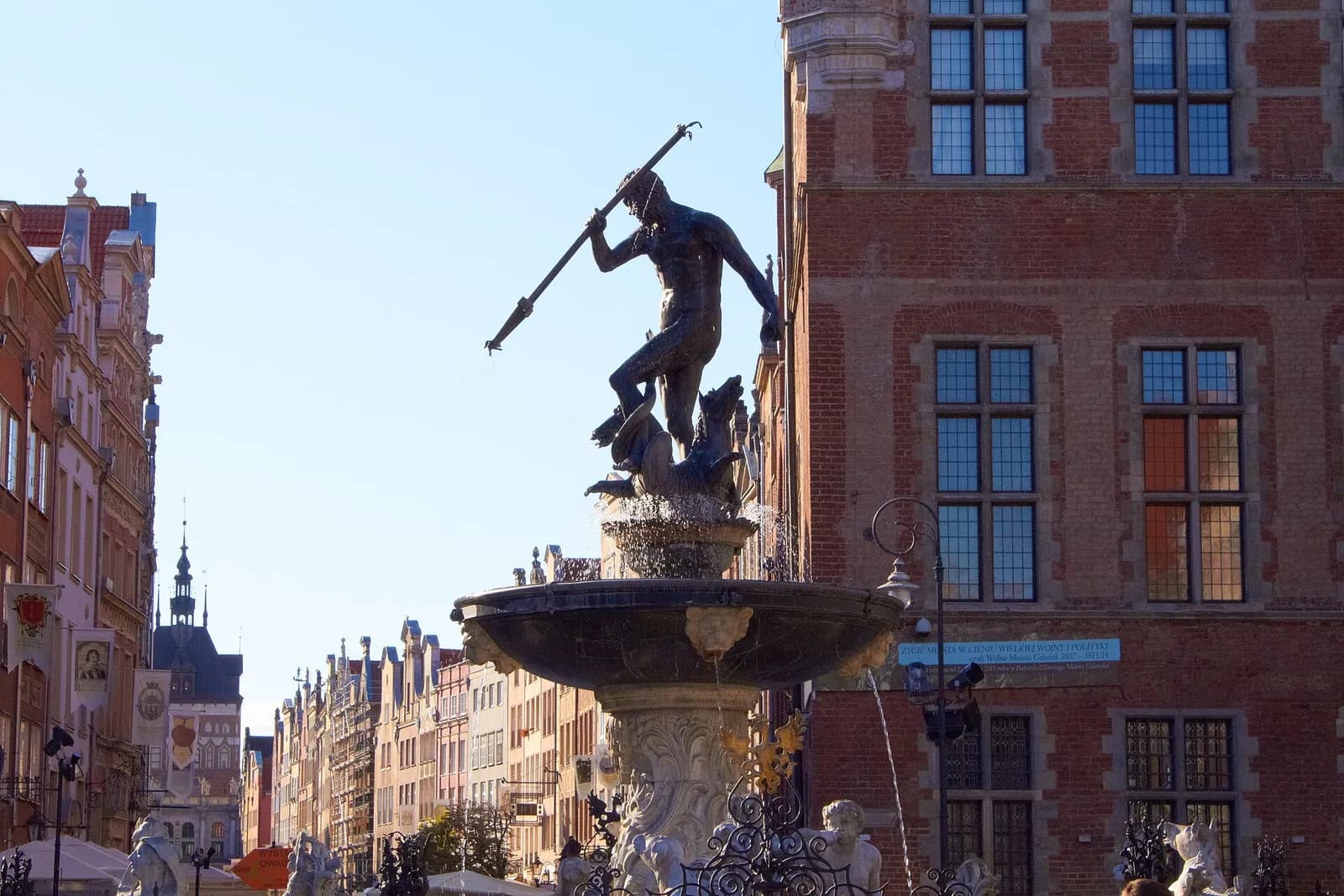
Standing at the centre of Długi Targ, with Artus Court behind him and the historic Main Town stretching towards the Motława, Neptune has watched over Gdańsk for almost four centuries.
The bronze figure of the Roman god of the sea is one of the city's most recognisable landmarks. He is also at the heart of one of Gdańsk's most entertaining legends, involving gold coins, an angry sea god and the creation of the city's famous Goldwasser liqueur.
There is a long history behind the fountain, but not everything told about Neptune belongs to the historical record.
A sea god for a maritime city
When the fountain was conceived in the early 17th century, Gdańsk was one of the most important trading cities on the Baltic.
The city's wealth was closely tied to the sea. Grain, timber and other goods passed through its port, connecting Gdańsk with markets across Europe. A statue of Neptune was therefore an appropriate choice for one of the city's most important public spaces.
The fountain was commissioned during the time of Gdańsk mayor Bartłomiej Schachmann. Its architectural and sculptural design is associated with Abraham van den Blocke, while the bronze figure was cast in 1615 by Peter Husen.
The completed fountain was finally put into operation on 9 October 1633.
Today, it stands directly in front of Artus Court, where the city's historic merchant culture provides an especially fitting backdrop.
Neptune was once green
The Neptune seen today is not quite the Neptune that people encountered in the 17th century.
The statue was originally painted a strong malachite green. Other details were brightly decorated too, with gilding used on elements including the trident and shell.
The effect would have been considerably more colourful than the bronze appearance familiar to people walking along Długi Targ today.
The fountain itself also developed over time. During the 18th century, its basin and pedestal were rebuilt and additional Rococo elements were introduced, giving the monument much of the appearance that became familiar in later centuries.
The decorative details are worth a closer look. Around Neptune are sea creatures including tritons, mermaids and seahorses, reinforcing the connection between the monument and the maritime character of the city.
A fountain that needed a city's water system
The fountain's original operation was rather different from simply turning on a modern water pump.
Water was stored in reservoirs located in the upper parts of buildings, including Artus Court and the Main Town Hall. From there, it could be supplied to the fountain.
This meant that Neptune did not simply run continuously. His operation depended on the city's water infrastructure and the available supply.
Gdańsk's developing water system eventually made the arrangement considerably easier, and the fountain became a permanent feature of the city's centre.
The legend of Neptune and the golden coins
The history of the fountain is fascinating enough, but Gdańsk also has a story about what happened when people started throwing gold coins into Neptune's water.
According to the legend, residents began tossing coins into the fountain.
Neptune was not impressed.
Eventually, the god of the sea became so irritated that he struck the water with his trident. The force of the blow shattered the coins into tiny pieces, turning the water golden.
This, the story says, was how Goldwasser came into being.
It is a wonderfully Gdańsk story. The city's maritime symbol, its historic wealth and one of its best-known products all meet in a single tale.
There is just one problem: Neptune did not actually invent Goldwasser.
The story belongs to local folklore. Goldwasser has a real history as a Gdańsk liqueur, while the explanation involving Neptune and the coins is a legend that grew around the drink and its unmistakable gold flakes.
Goldwasser and the 'Under the Salmon'
Another version of the story adds a little more intrigue.
The tale involves the historic Pod Łososiem, or "Under the Salmon", an inn associated with Gdańsk's Goldwasser tradition.
After Neptune supposedly transformed the coins into gold flakes, merchants hurried to collect the miraculous liquid. According to the legend, those who tried to take advantage of Neptune's gift were left with ordinary water.
The owner of the Under the Salmon, meanwhile, is said to have behaved differently and was rewarded with the precious drink.
As with many old legends, the details vary depending on who tells the story. It should be treated as folklore rather than a historical account, but it remains part of the colourful tradition surrounding Neptune and Goldwasser.
Neptune's wartime escape
The fountain has survived some turbulent chapters in Gdańsk's history.
During the Second World War, as the city suffered extensive destruction, the fountain was dismantled. Its individual parts were hidden in different locations, helping to protect the monument from the fighting.
Much of Neptune survived.
After the war, the fountain was reconstructed. Some elements had been lost and needed to be recreated, while the water system also required extensive repair.
The restored fountain returned to operation in the 1950s.
A major conservation programme followed in 2011 and 2012, when the sculpture, pedestal and water system were carefully restored.
That survival is particularly significant in a city whose historic centre had been so heavily damaged during the final months of the war.
Look closely at the details
It is easy to stop for a photograph and continue along Długi Targ. Neptune rewards a slower look.
The figure itself draws on classical sculpture but reflects the Mannerist style popular in Europe at the time. The pose is energetic, and the raised trident immediately establishes his identity.
Around the base, the maritime decoration continues the theme.
Look for the sea creatures woven into the composition, as well as the architectural details around the fountain. From different points along Długi Targ, Neptune appears against different parts of the historic streetscape.
His position was carefully chosen. Artus Court, the Main Town Hall and the surrounding merchant houses all form part of the setting.
The result is a monument that belongs to the street rather than simply occupying it.
A symbol rooted in Gdańsk's past
Neptune's place in Gdańsk makes sense once the city's history is taken into account.
He represents the Baltic and the sea routes that helped build the city's prosperity. His position beside Artus Court connects him with the merchants who shaped civic life. The Goldwasser legend adds another layer, bringing together the city's fascination with gold, trade and local craftsmanship.
And there is a nice contrast between the serious historical monument and the mischievous story attached to it.
The statue dates from the 17th century. The city around it has been rebuilt, altered and transformed many times. Yet the story of Neptune striking the water with his trident continues to be told.
A story worth knowing before you visit
Neptune is easy to recognise. Understanding the stories surrounding him makes the monument rather more interesting.
The fountain tells a genuine story about Gdańsk's maritime wealth, Renaissance and Mannerist art, changing water infrastructure and the destruction and reconstruction of the city after the Second World War.
Then there is the legend.
Neptune, the coins, the trident and the golden water may not be history, but they have become part of the way Gdańsk tells its own story.
See more: The Gdańsk Shipyard and the Story of Solidarity
Image credit: Araspaterka, Wikimedia Commons, CC BY-SA 3.0 pl